Choose what a row on the Nextedy SCHEDULER board represents — project users or the options of an enumeration field.
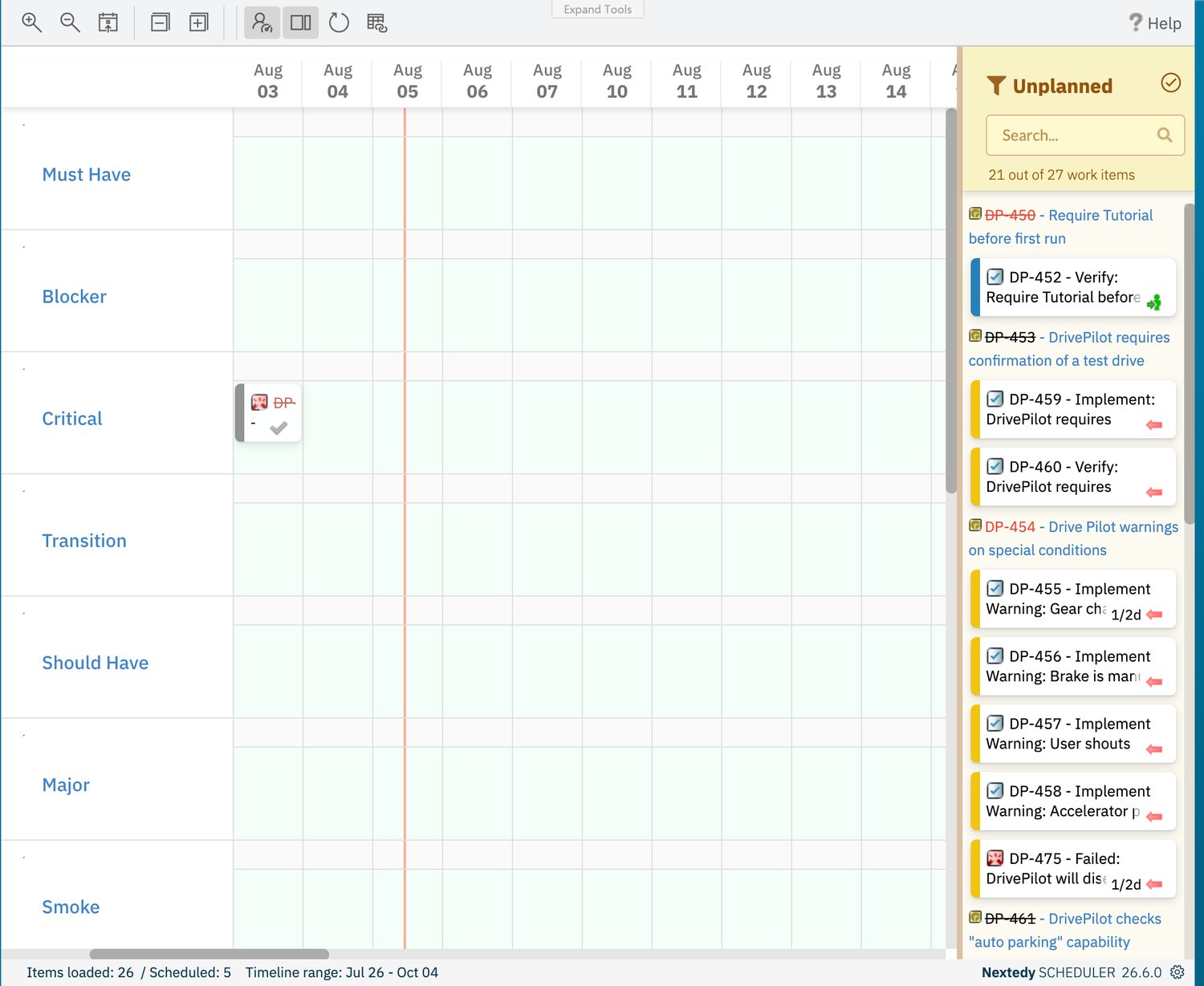
Rows on the Scheduler board are its swimlanes, and each row is a resource: work lands on a row, and the row carries the per-day load that results. The Assignment Type parameter decides what a resource is — a person, or an option of an enumeration field such as a team or a component.
Open the page holding the board, click Expand Tools in the upper toolbar, then click Edit.
2
Open the widget parameters
Select the Scheduler widget and choose Edit widget parameters.
3
Go to Swimlanes (Rows)
Find the Swimlanes (Rows) section. It is expanded when the editor opens and holds Assignment Type; a second parameter, Field ID, appears beneath it only once Assignment Type is set to Enumeration Field.
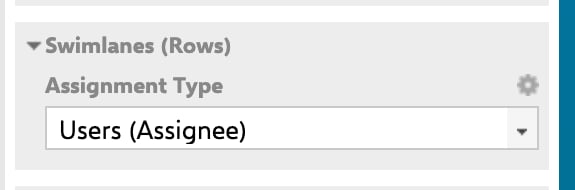
Users (Assignee) is the default Assignment Type. The board draws one row per project user and labels it with the user’s display name; a work item appears on the row of every user among its assignees, so an item assigned to two people shows on both rows.
1
Set Assignment Type to Users (Assignee)
In Swimlanes (Rows), set Assignment Type to Users (Assignee). Field ID is not used in this mode.
2
Decide which users get a row
The list of users comes from the User Role parameter, which lives in the Advanced section of the same parameter editor — not in Swimlanes (Rows).
Out of the box User Role is project_user, so the board shows one row per user holding that role in the project.
Set it to another role to restrict the board to that group, for example a role that only your planners hold.
Leave it empty to give every user in the project a row.
3
Apply and save
Apply the change and save the page, then reload the board and confirm the rows you expect.
User rows are measured against an eight-hour working day, so their load markers read as a figure over 8 — for example 6 / 8. See Capacity and Load.
A row’s name is rendered as a link, but the link has no real target — clicking it opens a new browser tab on a dead URL and changes nothing on the board. To narrow the board to one resource, use the Unplanned sidebar’s funnel filter instead: its Swimlanes submenu lists the board’s users and filters the backlog to the one you pick. See Filter the Unplanned Sidebar.
Switch Assignment Type to Enumeration Field when you plan by team, component, product line or any other enumeration rather than by person.
1
Set Assignment Type to Enumeration Field
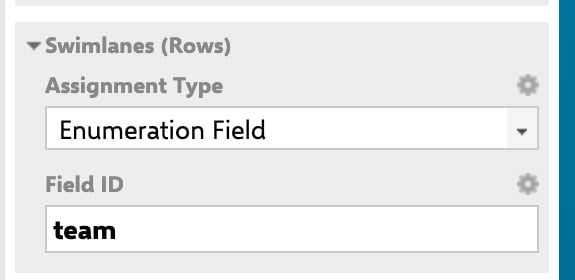
In Swimlanes (Rows), set Assignment Type to Enumeration Field. A Field ID parameter appears beneath it.
Selecting Enumeration Field reveals Field ID, pre-filled with team.
2
Enter the field ID
Type the ID of the enumeration field the rows should come from. This is the field’s ID as configured in Polarion, not its display label:
severity
The parameter arrives pre-filled with:
team
3
Apply and save
Apply the change and save the page. On reload, the board draws one row per option of that enumeration, labelled with the option’s name, and each work item appears on the row matching its value in that field.
Two differences from user rows are worth knowing before you switch:
Capacity. Enumeration rows are measured against a 24-hour day, so their load markers read as a figure over 24 rather than over 8. A row that stands for a whole team therefore reads very differently from a row that stands for one person.
What a drop writes. Dropping a card onto an enumeration row sets that work item’s value in the mapped enumeration field, where dropping onto a user row sets the assignee.
The default team only works if your project has a team enumeration. If you switch to Enumeration Field and apply without changing Field ID, the board reports that the field team does not exist or is not of type enumeration, and shows that error instead of rows. Set Field ID to a field that exists in your project.
Not every field can carry swimlanes, and the board tells you so in place of the rows rather than falling back to a default:
What you enter in Field ID
What the board does
An enumeration field that exists on your work items
Draws one row per option of that enumeration
status, resolution or type
Rejects it with a message that the field is not supported as a swimlane
A field that does not exist, or one that is not an enumeration
Rejects it with a message that the field does not exist or is not of type enumeration
Both rejections replace the rows, so the symptom is the same: a board with a field error and no swimlanes on it. Correct Field ID and reload.
If you need rows by status, resolution or type, that is a job for the board’s query rather than its rows: give each of those slices its own Scheduler page, or add a named query in the Queries section so planners can filter the backlog to it.
Reload the page and count the rows — one per user in the configured role, or one per option of the enumeration field.
Check a row label against the source: a user’s display name, or the enumeration option’s name.
Check a load marker on a busy row — it should read against 8 for user rows and against 24 for enumeration rows.
Drag a card out of the Unplanned sidebar onto a row, then open the work item: its assignee (user rows) or its enumeration field (enumeration rows) should now hold that row’s value.
If a field error appears instead of rows, re-check Field ID against the field’s ID in Polarion.